
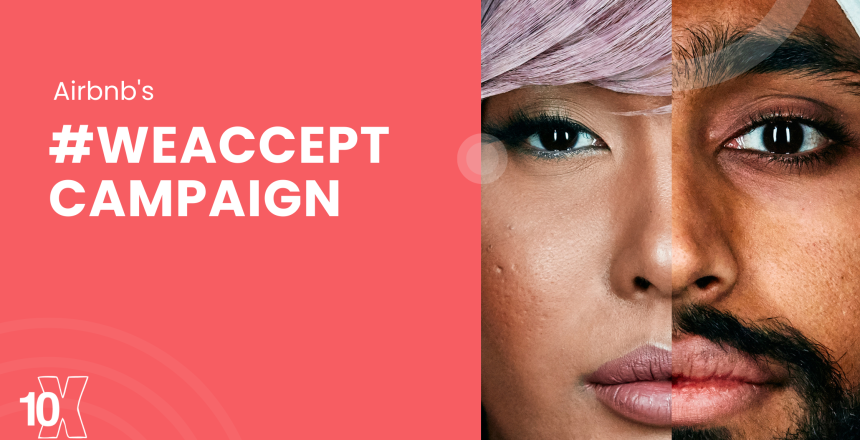
Airbnb’s #weaccept campaign was a powerful demonstration of the company’s commitment to diversity and inclusion. In response to the executive order issued by the Trump administration banning travelers from several Muslim-majority countries, Airbnb launched the #weaccept campaign to show support for those affected by the ban.
The campaign featured a video that showed people from different backgrounds holding up signs with the hashtag #weaccept, and it also included a pledge by Airbnb to provide short-term housing to 100,000 people in need over the next five years. This was a bold and compassionate move by the company, and both customers and the media widely praised it.
One of the most impressive aspects of the campaign was how it brought people together. By showing individuals from all walks of life holding up signs with the #weaccept hashtag, Airbnb demonstrated the power of inclusivity and the importance of standing up for those in need.
In addition to the emotional impact of the campaign, it also had a practical effect. By offering to provide short-term housing to 100,000 people in need, Airbnb was able to make a tangible difference in the lives of many individuals and families who had been affected by the travel ban.
Overall, the #weaccept campaign was a huge success for Airbnb. It not only showed the company’s commitment to diversity and inclusion but also helped bring people together and make a real difference in the lives of those in need.
Reasons for the success of Airbnb’s #weaccept campaign
Airbnb’s #weaccept campaign was successful for a number of reasons:
- Timing: The campaign was launched shortly after implementing the controversial travel ban in the United States, which sparked widespread public outrage and protests. As a result, the campaign resonated with people who were looking for ways to show support for diversity and inclusion.
- Strong message: The campaign’s acceptance and inclusion message was powerful, timely, and aligned with Airbnb’s brand values and mission.
- Emotional appeal: The campaign was able to tap into people’s emotions by highlighting the importance of acceptance and belonging. This helped to create a strong emotional connection with consumers.
- Use of social media: The campaign was heavily promoted on social media, where people could share pictures of themselves holding signs with the #weaccept hashtag. This helped to generate buzz and drive word-of-mouth marketing.
- Celebrity endorsements: The campaign featured celebrities’ endorsements, which helped increase its visibility and credibility.
- Positive media coverage: The campaign received widespread media coverage, which helped to amplify its message and reach a larger audience.
Limitations to Airbnb’s #weaccept campaign
There were a few limitations to Airbnb’s #weaccept campaign:
- Limited geographical availability: The campaign was only available in certain countries, so it was not accessible to all consumers worldwide.
- Limited time frame: The campaign had a fixed end date, which may have limited its overall impact and reach.
- Limited budget: Like any marketing campaign, Airbnb’s #weaccept campaign had a limited budget, which may have limited the scope and reach of the campaign.
- Competition: The campaign faced competition from other brands and products, which may have limited its impact on consumer behavior and purchasing decisions.
- Potential backlash: The campaign was launched in response to a controversial political issue, which may have resulted in backlash from certain groups of people who disagree with Airbnb’s stance.
- Limited control over messages: As with any campaign that relies on user-generated content, Airbnb had limited control over the messages and images that were shared using the #weaccept hashtag. This could have potentially led to harmful or inappropriate content associated with the campaign.
Marketing lessons from Airbnb’s #weaccept campaign
There are several marketing lessons that can be learned from Airbnb’s #weaccept campaign:
- Timing is essential: The campaign was launched when there was widespread public outrage and protests in response to the travel ban in the United States. This demonstrates the importance of considering timing in marketing campaigns.
- Strong messages can be effective: The campaign’s message of acceptance and inclusion was powerful and timely, and it aligned with Airbnb’s brand values and mission. This shows the importance of having a clear and compelling message in marketing campaigns.
- Emotional appeal can be effective: The campaign tapped into people’s emotions by highlighting the importance of acceptance and belonging. This demonstrates the importance of using emotional appeal in marketing to connect with consumers on a deeper level.
- Social media can be a powerful tool: The campaign was heavily promoted, which helped generate buzz and drive word-of-mouth marketing. This shows the importance of having a solid social media presence and leveraging social media platforms to reach and engage consumers.
- Celebrity endorsements can increase visibility and credibility: The campaign featured endorsements from celebrities, which helped to increase its visibility and credibility. This shows the potential value of celebrity endorsements in marketing campaigns.
- Positive media coverage can amplify a campaign’s message: The campaign received widespread media coverage, which helped to amplify its message and reach a larger audience. This demonstrates the importance of seeking positive media coverage for marketing campaigns.